


Edited by Dilys White
The importance of reflection in clinical psychology cannot be overstated. It’s a process, as highlighted by Conway (1994), of retrospection and learning from past experiences, identifying what was effective and what wasn’t and thoughtfully planning future actions.
Continuing from last week’s blog, in which we explored Rolfe’s Reflective Framework, let’s delve into another model of reflection: Kolb’s (1984) Experiential Learning Cycle. This blog post aims to provide an in-depth exploration of the model, highlighting its principal components, strengths and limitations. Kolb’s (1984) Experiential Learning Cycle serves as a guide for aspiring clinical psychologists to systematically analyse experiences and improve skills and self-awareness in a structured and meaningful way.
Why was Kolb’s (1984) Experiential Learning Cycle developed?
The development of Kolb’s (1984) Experiential Learning Cycle was a response to the shifting paradigms in education during its time. It was a period marked by a growing scepticism towards conventional teaching methods and an increasing appreciation for experiential learning as an effective educational approach. Kolb’s model was significantly influenced by the theories of renowned psychologists like Dewey (1938), Piaget (1972), and Lewin (1951), who all highlighted the critical role of active participation and reflective thinking in learning. Integrating these insights, Kolb’s framework emerged as a valuable tool, offering a structured method for individuals to undergo transformative learning journeys, thereby catalysing both personal and professional development.
Key Elements of Kolb’s (1984) Experiential Learning Cycle
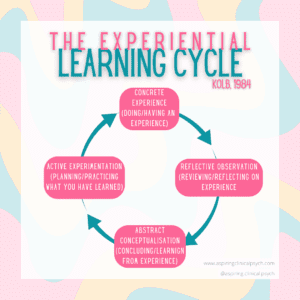
Kolb’s (1984) Experiential Learning Cycle includes four simple but essential steps: Concrete Experience, Reflective Observation, Abstract Conceptualisation, and Active Experimentation.
First comes Concrete Experience. In this step, aspiring clinical psychologists really get involved in actual situations or events. They pay close attention to how they feel, how they react, and what important things happen during these experiences. This is where they think about how patients act in therapy, what goes well, what doesn’t, and their own thoughts and feelings. They also think about how their background and beliefs affect their work. By looking closely at these real-life experiences, they lay the groundwork for the next steps.
Next is Reflective Observation. Here, aspiring clinical psychologists take time to think deeply about their experiences. They consider why they think and react the way they do and how this shapes their view of the situation. This step involves looking closely at how they interact with patients and the effect this has on their therapy sessions. They think about what worked, what didn’t, and why, which helps them understand their experiences better and prepares them for the next step.
Then comes Abstract Conceptualisation. In this stage, aspiring clinical psychologists connect their real-world experiences with what they already know from books and theories. They think about how these experiences fit with or challenge what they know. They use their knowledge and expertise to make sense of what happened and think about what it means for their work as therapists. This helps them improve how they do their job.
Lastly, there’s Active Experimentation. In this final step, aspiring clinical psychologists use what they’ve learned to make changes in how they work. They try out new ideas and methods based on their new understanding. They keep an eye on how well these new approaches work and make changes if needed. They use their new knowledge in real-life situations with patients, always aiming to get better at what they do. This step shows their commitment to always learning and improving in their job.
Strengths of Kolb’s (1984) Experiential Learning Cycle
A major plus of Kolb’s (1984) model is how it focuses on the need for active involvement and thoughtful reflection when learning. The model really pushes people to try things out and think deeply about what they’ve done, leading to a stronger grasp of knowledge. It also shows learning as a repeating process, where you can keep going back to improve and deepen your understanding. This opens the door for ongoing growth and development. Another great point about the model is how straightforward and user-friendly it is, making it useful in a lot of different work areas, especially in clinical psychology.
Limitations of Kolb’s (1984) Experiential Learning Cycle
Kolb’s (1984) Experiential Learning Cycle, while insightful, does have its drawbacks. A notable concern is that the model might simplify the learning process too much. It doesn’t really consider the varied ways people learn and their personal preferences. Also, the way the model is set up in a step-by-step manner may not fully represent how learning can often be more unpredictable and not always a straight line. Another point is that the model puts a lot of emphasis on learning by oneself. It might not give enough credit to the role of learning with others, which is especially important in clinical psychology, where working as part of a team and collaborating with different disciplines is key.
To summarise…
Kolb’s (1984) Experiential Learning Cycle provides a structured path for meaningful self-reflection and ongoing professional development, preparing you for clinical psychology doctorate training.
Interested in further exploring these concepts? We invite you to join our Monthly Reflective Workshops. Sign up to our mailing list to receive an invitation and stay connected with the latest Aspiring Clinical Psych support and services.
Best wishes,
Edited by Dilys White, Aspiring Clinical Psych Content Assistant
Are you an aspiring clinical psychologist wondering how to prepare for DClinPsy? Click here to find out more about how we support aspiring clinical psychologists.
References
Conway, J. (1994). Reflection, the art and science of nursing and the theory-practice gap. British Journal of Nursing, 3(3), 114-118. https://doi.org/10.12968/bjon.1994.3.3.114
Conway, J. (1994). Reflection, the art and science of nursing and the theory-practice gap. British Journal of Nursing, 3(3), 114-118. https://doi.org/10.12968/bjon.1994.3.3.114
Dewey, J. (1938). Experience and education. Kappa Delta Pi.
Kolb, D. A. (1984). Experiential learning: Experience as the source of learning and development. Prentice-Hall.
Lewin, K. (1951). Field theory in social science: Selected theoretical papers. Harper & Row.
Piaget, J. (1972). The psychology of the child. Basic Books.
Schön, D. A. (1983). The reflective practitioner: How professionals think in action. Basic Books.
Vygotsky, L. S. (1978). Mind in society: The development of higher psychological processes. Harvard University Press.
Wenger, E. (1998). Communities of practice: Learning, meaning, and identity. Cambridge University Press.
