

By Dr Melody Smith, Clinical Psychologist
If you are preparing your DClinPsy application, you may know the strange feeling of having so much experience to draw on and yet struggling to find the words. Perhaps your draft does not quite sound like you, or your reflections seem impossible to organise. DClinPsy application support can help with practicalities, but reflective writing for DClinPsy applications raises a more personal question: how do you communicate the psychologist you are becoming? Our fourth annual DClinPsy Application Writing Retreat returns this October, and perhaps the most useful part of the weekend is something you have not yet made time for.

Writing an Application Is More Than Filling in a Form
Applications invite us to revisit work, research, supervision and personal experiences, then decide what these say about our development. That can be surprisingly difficult. We might focus on the title of a role or the outcome of a project and lose sight of the thinking that happened along the way.
Describing how you supported someone tells a reader what you did. Exploring how you adapted your approach, questioned an assumption or responded to feedback communicates what you learnt. Reflection is not about making every experience sound extraordinary. It is about being specific about what changed and why it matters.
Research into reflective practice in health professions education recognises its importance whilst acknowledging uncertainty about the most effective ways to teach it (Mann et al., 2009). Sometimes, we need space to think before attempting to make every sentence impressive.
Why We Prioritise Protected Writing Time
The retreat is returning for its fourth year because the writing itself deserves attention. Across Saturday 17 and Sunday 18 October, we will meet online through BigBlueButton for teaching, discussion, questions and six structured writing blocks.
You will spend time working directly on your application rather than listening to presentations all weekend. At the beginning of each block, you could choose a realistic goal: draft a section, develop a reflection or strengthen something already written. Afterwards, you could take time to consider what moved forward and what still needs attention.
Research on structured writing retreats amongst academics highlights the benefits of dedicated writing time and collegiality (Murray & Newton, 2009). Goal-setting research also suggests that specific, suitably challenging goals can improve task performance (Locke & Latham, 2002). These studies do not examine DClinPsy applications, but their findings offer useful principles for designing a focused writing space.
What Previous Retreats Have Taught Us
Feedback from previous retreats has been encouraging and has also helped us refine our approach. Attendees have valued working alongside others, setting targets and recognising that they are not alone in finding applications demanding. Discussions about the 12 ACPsych Competencies and opportunities to hear trainee perspectives were also appreciated.
Some people wanted more concrete examples, deeper exploration of reflective writing and more opportunities to ask questions. Others preferred shorter check-ins to protect writing time. We take this feedback seriously. Supportive critique matters, and the structure of a retreat should remain responsive to the people attending.
This year, protected writing time remains central, with teaching and discussion placed throughout the weekend so you can put new ideas into practice straight away.
What Can You Expect This October?
I will lead the retreat alongside current Trainee Clinical Psychologists Po Ling Chan, Hannah Lamplough, Saira Mahmood and Rachel Noon. Together, we will explore approaching the application, understanding the 12 ACPsych Competencies and communicating experience, learning and development.
Trainee-led sessions will bring perspectives from people who have recently navigated applications and entered training. Reflective writing discussions, Q&As and opportunities to review progress will sit alongside writing blocks, leaving you free to concentrate on the sections most relevant to you.
You do not need a polished draft. If you are only beginning, you can explore your ideas and start writing. If you are further along, you can revisit clarity, coherence and whether your application reflects your values. You do not need to disclose confidential clinical information to participate.
Progress, Not Perfection
A writing retreat cannot promise an interview or a place on training. It can offer structure, connection and the chance to move forward without having every answer. Progress might be a completed paragraph, a clearer example or recognising what you no longer need to include.
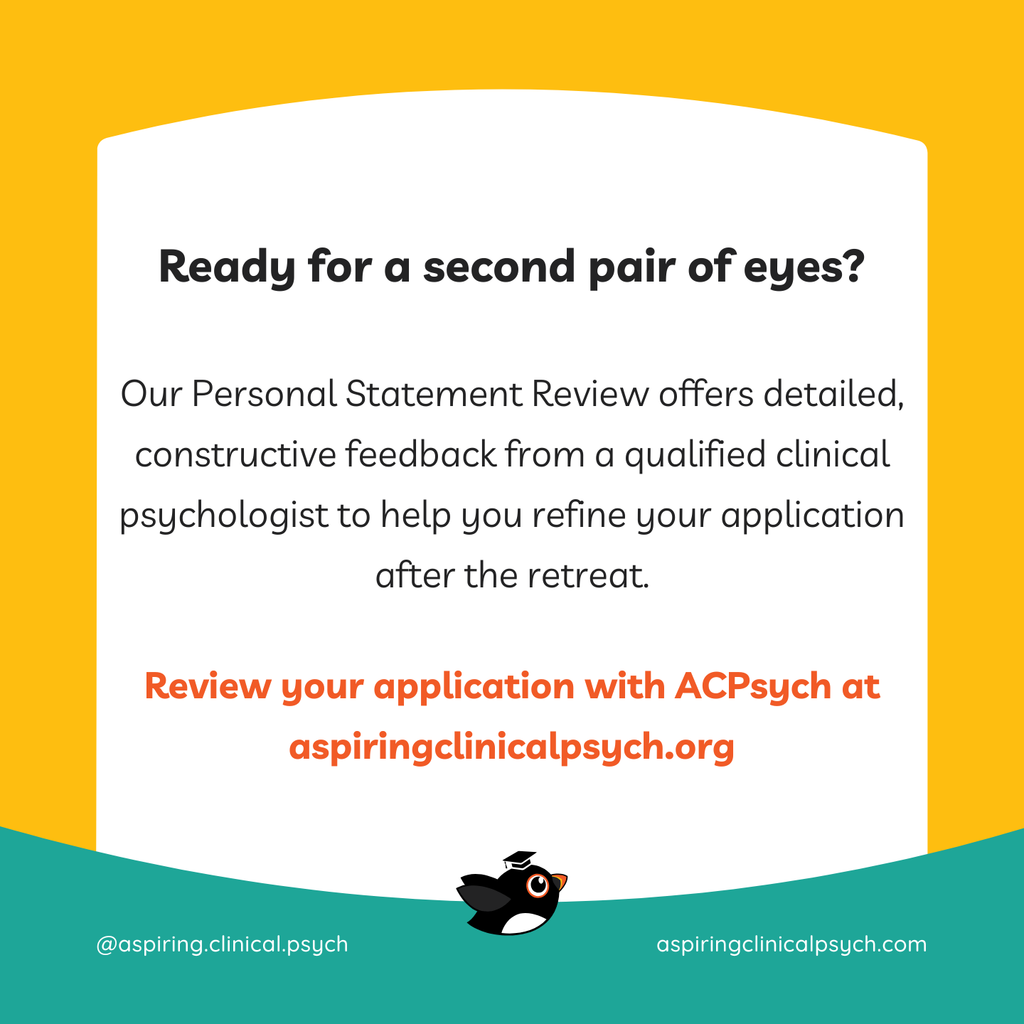
If you are applying this year, we would love to welcome you on 17–18 October. Come with your draft, your notes or even your uncertainty. Bring questions and a willingness to think differently about what you have done. You deserve a supportive space to tell your story thoughtfully, remembering that becoming a psychologist is an ongoing process, not something you must prove in one weekend.
References
Locke, E. A., & Latham, G. P. (2002). Building a practically useful theory of goal setting and task motivation: A 35-year odyssey. American Psychologist, 57(9), 705–717. https://doi.org/10.1037/0003-066X.57.9.705
Mann, K., Gordon, J., & MacLeod, A. (2009). Reflection and reflective practice in health professions education: A systematic review. Advances in Health Sciences Education, 14(4), 595–621. https://doi.org/10.1007/s10459-007-9090-2
Murray, R., & Newton, M. (2009). Writing retreat as structured intervention: Margin or mainstream? Higher Education Research & Development, 28(5), 541–553. https://doi.org/10.1080/07294360903154126
Disclaimer
This blog is intended for educational and reflective purposes only and does not constitute psychological, medical or legal advice. The views discussed are designed to encourage thoughtful reflection and professional development amongst aspiring clinical psychologists. Readers are encouraged to engage critically, utilise ACPsych Hub resources, seek supervision where appropriate, and refer to current professional guidance and evidence-based practice standards.
