

By Dr Melody Smith, Clinical Psychologist
Accessibility in psychology is often discussed in relation to clinical practice: adapting interventions, considering cultural context, or ensuring that services are inclusive. Yet accessibility matters just as much in education. Aspiring psychologists come from a wide range of backgrounds and circumstances. Some are balancing full-time jobs alongside applications, while others are navigating caring responsibilities, financial pressures, disabilities, neurodivergence, or simply the challenge of fitting study around everyday life. As Aspiring Clinical Psych continues to grow, we have been asking ourselves an important question: how can we create a learning environment that genuinely works for the diverse community we serve? The answer has led to some exciting changes across the ACPsych Hub—and this is only the beginning.
For many aspiring clinical psychologists, learning rarely happens in ideal conditions. Revision takes place on train journeys, after long NHS shifts, during lunch breaks, or late at night after children have gone to bed. There is no single “right” way to learn, and educational spaces that assume otherwise risk leaving people behind.
Over the past year, accessibility has become an increasingly important focus for us. It is not simply about meeting technical standards or ticking boxes. It is about recognising that everyone deserves the opportunity to engage with psychological ideas in ways that feel manageable, meaningful, and sustainable.
Accessibility Is About More Than Compliance
When people hear the word “accessibility”, they often think of ramps, subtitles, or large-print materials. These are, of course, essential. But accessibility in education is much broader than that.
Educational researchers have increasingly argued that learning environments should provide multiple ways for people to engage with content, communicate their understanding, and participate in learning (CAST, 2018). Some people absorb information best by reading, while others prefer listening or combining different approaches.
For aspiring psychologists, this matters enormously. Clinical psychology attracts people with varied experiences, identities, strengths, and life circumstances. A platform that works perfectly for one person may present barriers for another.
True accessibility asks a simple question: how can we adapt the environment, rather than expecting people to adapt themselves?
What’s New on the ACPsych Hub?
As part of our ongoing commitment to accessibility, we’ve recently introduced a range of new features powered by Brickfield Education Labs.
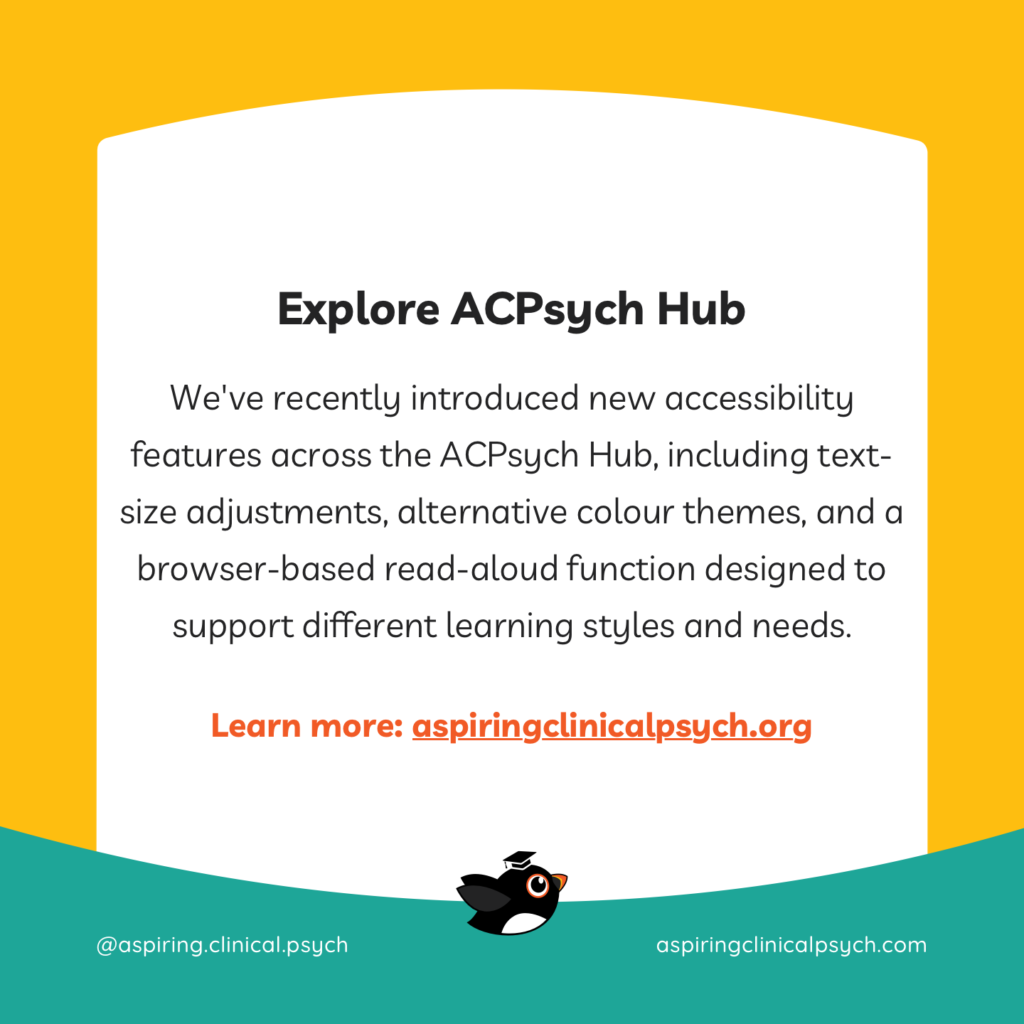
Learners can now customise their experience in several ways. Text size can be increased or decreased to reduce visual strain, colour themes can be adjusted to improve readability, and a built-in read-aloud function allows users to listen to course content directly from their browser.
Importantly, these features are integrated into the platform itself. There is no need to install additional software or purchase specialist technology. Whether you are revising on your phone during your commute or listening to a lesson while preparing dinner, the goal is to make learning more flexible and responsive to real life.
Accessibility tools can benefit everyone. Captions help people studying in noisy environments. Audio functions can support revision while multitasking. Larger text can reduce fatigue after long periods of screen time. Features initially designed to support specific needs often improve the experience for all learners.
Listening and Learning as an Organisation
This commitment to accessibility did not emerge overnight.
Last year, an aspiring psychologist kindly contacted us to explain that aspects of our branding and website design could be improved from an accessibility perspective. That feedback challenged us to pause, reflect, and rethink how we presented ourselves.
Over several months, we redesigned our branding, refined our colour palette, and reconsidered how learners interact with our resources. It was a reminder that meaningful change often begins with listening.
Co-production is central to psychology. Clinical psychologists regularly work alongside service users, families, and communities to shape interventions and improve services. Perhaps educational spaces should be no different.
We are incredibly grateful to everyone who has offered feedback, challenged our assumptions, and helped us continue to grow.
Why Accessibility Matters for Future Clinical Psychologists
Clinical psychology has evolved considerably over the past century, expanding into a wide range of settings and populations. Contemporary psychologists are increasingly expected to think critically about diversity, context, and inclusion in both clinical and educational environments. What is Clinical Psychology? describes how the profession continues to develop in response to changing social needs and a growing recognition of diversity within healthcare.
Accessibility is not separate from these conversations—it is part of them.
As future psychologists, many of you will work with people whose needs differ significantly from your own. You may support individuals who communicate differently, process information differently, or experience barriers that are not immediately visible.
Learning to think about accessibility now is, in many ways, preparation for clinical practice later.
Books such as Surviving Clinical Psychology have highlighted the importance of reflecting on power, identity, and the barriers that shape who feels able to enter and thrive within the profession. Accessibility encourages us to ask difficult but important questions:
Who finds psychology accessible?
Who encounters barriers?
What assumptions do our educational and professional systems make?
And how might we do things differently?
Accessibility Beyond Technology
Improving accessibility is about much more than software features.
It influences how we write our courses, structure our workshops, and facilitate discussions. Over time, we’ve tried to move towards shorter lessons, clearer language, reflective prompts, and flexible learning activities that encourage curiosity rather than perfectionism.
This philosophy aligns closely with our educational framework, which emphasises the importance of helping aspiring psychologists build confidence, professional identity, and reflective skills alongside academic knowledge.
After all, psychology is not simply about acquiring information. It is about learning how to think critically, work collaboratively, and understand the complexity of human experience.
Creating accessible educational spaces supports all of those goals.

Looking Ahead
Accessibility is not a destination that can ever truly be reached. It is an ongoing process of listening, adapting, and learning.
The changes we’ve introduced this year represent one step in that journey, but there is still much more to do. We know that the most valuable insights often come from the people who use our resources every day, and we remain committed to improving the ACPsych Hub in partnership with our community.
Because accessibility is about far more than removing barriers.
It is about creating spaces where more people can see themselves reflected, supported, and able to succeed.
And, perhaps most importantly, it is about ensuring that aspiring psychologists know that they belong here too.
References
CAST. (2018). Universal design for learning guidelines version 2.2. CAST.
Cheshire, K., & Pilgrim, D. (2004). A short introduction to clinical psychology. Sage Publications.
Llewelyn, S., & Murphy, D. (Eds.). (2014). What is clinical psychology? (5th ed.). Oxford University Press.
Randall, J. (Ed.). (2020). Surviving clinical psychology: Navigating personal, professional and political selves on the journey to qualification. Routledge.
Disclaimer
This blog is intended for educational and reflective purposes only and does not constitute psychological, medical, or legal advice. The views discussed are designed to encourage thoughtful reflection and professional development within aspiring clinical psychologists. Readers are encouraged to engage critically, utilise ACPsych Hub resources, seek supervision where appropriate, and refer to current professional guidance and evidence-based practice standards.
