

By Dr Melody Smith, Clinical Psychologist
Postpartum psychosis has recently been brought into wider public conversation through the highly publicised Lindsay Clancy case in the United States. For aspiring clinical psychologists, this creates an opportunity to think about something that extends far beyond one case: when mental health becomes headline news, how do we separate what has been reported from what the wider evidence can actually tell us? And perhaps more importantly, how confident are we at noticing when we do not yet have enough information to reach a conclusion?
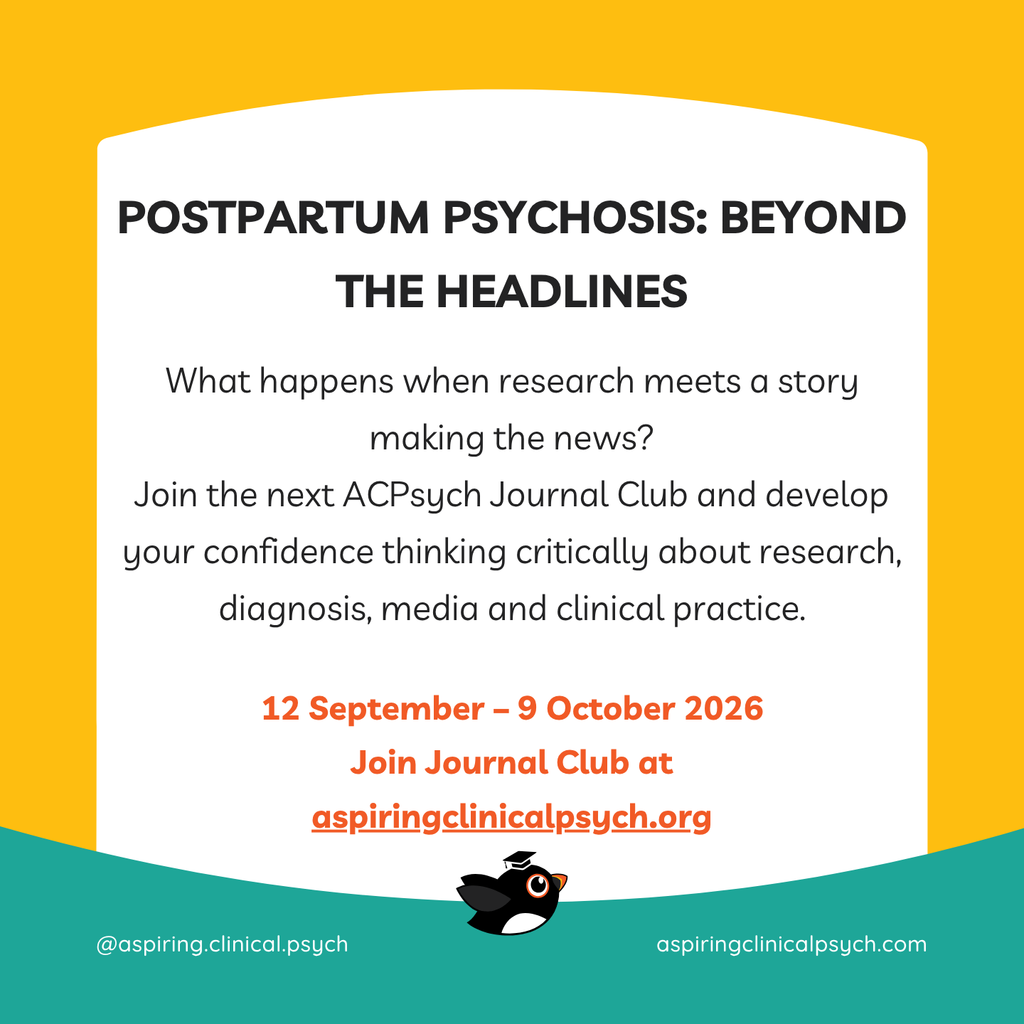
These are exactly the kinds of questions we will be exploring in the next ACPsych Journal Club: Postpartum Psychosis Beyond the Headlines. Rather than simply reading a research paper in isolation, we will place research alongside current media reporting, clinical perspectives, diagnostic debates and lived experience, creating space to think critically about where psychological knowledge comes from.
Why This Journal Club, and Why Now?
The paper at the centre of this Journal Club is Kamperman et al.’s (2017) study of the characteristics of postpartum psychosis.
One of the things that makes the paper particularly interesting is that it challenges the idea that postpartum psychosis has one obvious or easily recognisable presentation. The researchers identified different patterns of experiences, which they labelled “depressive”, “manic” and “atypical”.
But our Journal Club will not stop at asking “What did the study find?”
Instead, the paper gives us somewhere to begin.
What happens when the picture presented in research differs from the picture we encounter through a high-profile news story? How were the researchers’ conclusions reached? Would we expect the same findings in another country or healthcare system? What role do diagnostic classifications play? And whose experiences may be missing from both research and public discussion?
These questions are particularly relevant when a condition is receiving intense media attention.
A news report, a clinical study, an expert opinion and a lived-experience account can all contribute something important. But they do not necessarily answer the same questions.
Learning to recognise that difference is an important part of developing as a psychologist.
More Than a Traditional Journal Club
ACPsych Journal Club has been designed specifically for aspiring psychologists who want to become more confident engaging with research without feeling that they need to be an expert before they begin.
You will not be expected to arrive with a perfect critique.
You will not be tested on the statistics.
And you do not need to read everything in one sitting.
Instead, we take one paper and explore it gradually.
We start by asking what stands out and what makes us curious. From there, we begin looking beneath the findings: who participated, how the research was conducted and what those choices might mean for the conclusions being drawn.
As the conversation develops, we move beyond the paper itself and ask what the research might mean for clinical practice, professional thinking and wider questions around culture, diagnosis, ethics and representation.
The aim is to help you move beyond simply identifying a study’s “strengths and limitations” towards being able to say:
What does this evidence help me understand — and where should I remain cautious?
How Journal Club Works
Journal Club takes place asynchronously in the ACPsych Hub, making it easier to fit around work, study and other commitments.
There is no live session you need to attend.
A structured discussion is introduced each week, giving you a clear place to focus your thinking. You can contribute your own reflections, respond to other participants or simply follow the conversation while you build confidence.
Facilitator contributions help take discussions further, introducing additional questions, teaching points or perspectives where useful. We may also draw on other sources alongside the main paper, including professional guidance, newer research, lived-experience perspectives and carefully selected media coverage.
For Postpartum Psychosis: Beyond the Headlines, this means we will have opportunities to think about the current public conversation surrounding postpartum psychosis while being careful not to treat media coverage as clinical evidence about an individual.
We will also consider emerging debates about how postpartum psychosis is classified, differences across cultural and healthcare contexts, and the importance of hearing experiences of treatment and recovery alongside accounts of serious risk.
The facilitated Journal Club runs from 12 September to 9 October 2026.
If you cannot follow along during those dates, the learning does not disappear. The Journal Club will remain within the Journal Club Archive, allowing you to return to the article, discussions and additional resources in your own time.
Developing Skills That Travel Beyond One Paper
The topic may be postpartum psychosis, but the skills we will practise apply much more widely.
As an aspiring clinical psychologist, you are likely to encounter research in applications, AP and DClinPsy interviews, service evaluation, audit, clinical work and conversations within multidisciplinary teams.
Being able to critically discuss evidence involves more than remembering research terminology.
It means noticing when a conclusion goes beyond the data.
It means thinking about who was represented in a study and who was not.
It means recognising that diagnostic frameworks can be useful without assuming that they provide a complete explanation of someone’s experience.
And increasingly, it means being able to approach psychological claims circulating through news and social media with curiosity rather than immediate certainty.
These are habits that develop through practice.
Journal Club gives you somewhere supportive to practise them.
Final Thoughts
A high-profile news story can make us curious about a mental health condition. It can start conversations and encourage us to look more closely.
But it should not have to provide the whole picture.
Our next Journal Club is an invitation to do exactly that: look more closely.
We will begin with research, question how that knowledge was produced, bring in different perspectives and practise holding uncertainty when the available evidence does not provide a simple answer.
You do not need to be confident with research before joining. Developing that confidence is part of the point.
If you are an aspiring psychologist who wants a structured, accessible way to strengthen your research literacy, reflective thinking and professional voice, we would love to have you join Postpartum Psychosis: Beyond the Headlines in the ACPsych Hub.
References
Action on Postpartum Psychosis. (n.d.). Media information for journalists and content creators. Action on Postpartum Psychosis.
Bergink, V., Akbarian, S., Byatt, N., Chandra, P. S., Cirino, N., Dazzan, P., et al. (2026). Postpartum psychosis and bipolar disorder: Review of neurobiology and expert consensus statement on classification. Biological Psychiatry, 99(9), 740–747. https://doi.org/10.1016/j.biopsych.2025.10.016
Fusar-Poli, P., Estradé, A., Mathi, K., Mabia, C., Yanayirah, N., Floris, V., et al. (2025). The lived experience of postpartum depression and psychosis in women: A bottom-up review co-written by experts by experience and academics. World Psychiatry, 24(1), 32–45. https://doi.org/10.1002/wps.21264
Kamperman, A. M., Veldman-Hoek, M. J., Wesseloo, R., Robertson Blackmore, E., & Bergink, V. (2017). Phenotypical characteristics of postpartum psychosis: A clinical cohort study. Bipolar Disorders, 19(6), 450–457. https://doi.org/10.1111/bdi.12523
Disclaimer
This blog is intended for educational and reflective purposes only and does not constitute psychological, medical or legal advice. The views discussed are designed to encourage thoughtful reflection and professional development within aspiring clinical psychologists. Readers are encouraged to engage critically, utilise ACPsych Hub resources, seek supervision where appropriate, and refer to current professional guidance and evidence-based practice standards.
